
In a world so often plagued by bleak dystopia, Project Hail Mary stands in stark opposition to this very continuity. In spite of the impending doom being levied against all of planet Earth, the picture perfectly balances this bleak plight with some of the most endearing moments I’ve seen in film. As someone who adores the novel from which the movie is based, I can thoroughly say that this is possibly the best book-to-film adaptation I’ve ever seen. While some of my favorite moments from the novel didn’t quite make the cut for the film, what is preserved is simply so perfect that I didn’t really find myself missing those scenes all too much. Something I would like to note before I continue is just how short this film felt. The film clocks in at two hours and thirty-two minutes, but for me, this film hardly felt like an hour and thirty minutes. I think much of this feeling simply comes down to editing decisions; the pace of the overall film is rather brisk, with the movie never really feeling glacial or as if it were holding on to a plot point too long. If anything, I would have really loved it if this film could have been a little longer. I really felt like it just breezed past, and whilst leaving a large impression upon me, I couldn’t help but want to see more of the universe. I still heavily desired to garner a deeper understanding of all of the idiosyncrasies of the cast.
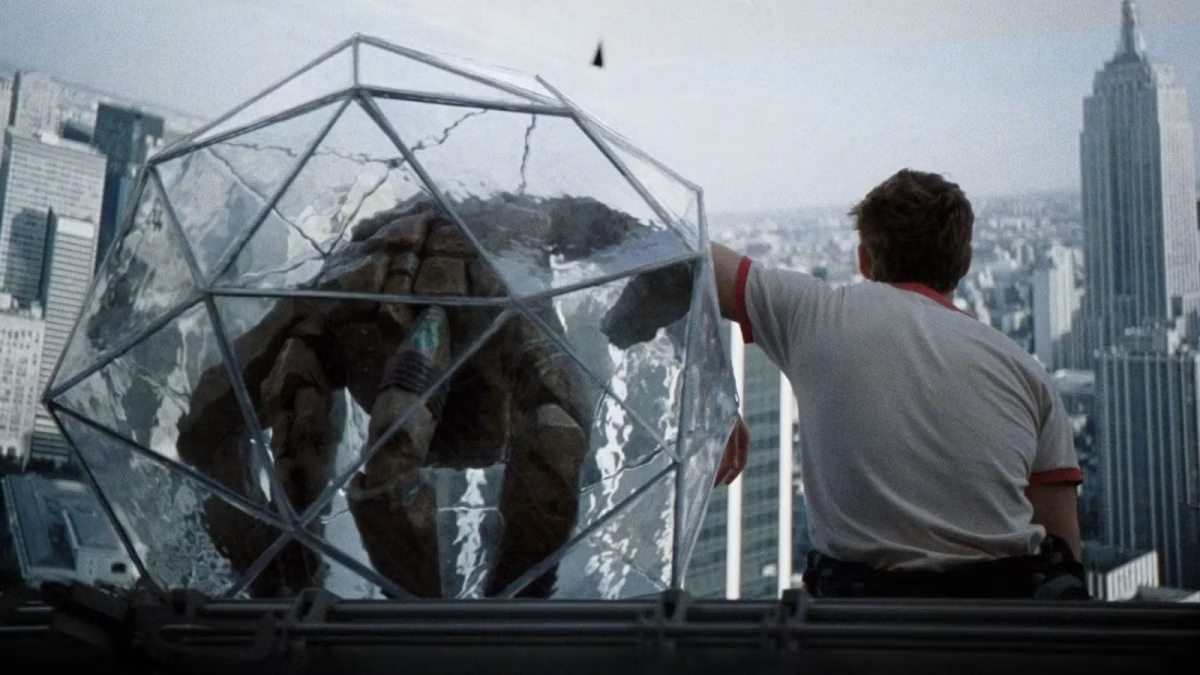
This may just be the most visually beautiful film I’ve ever watched. The use of color throughout the film even rivals Wes Anderson’s vivid sets; every frame simply felt magical, where even the mundane feels picturesque. The colors of this film are so incredibly varied, aiding in preserving the movie’s feeling of freshness throughout its entire runtime. The cinematography similarly stunned me to the point where I couldn’t even fathom how some of these scenes were captured to begin with. So many shots involve incredibly complex camera maneuvers, which seem nearly impossible to achieve. Even now, I ponder how they achieved the long-take when Rocky first enters Grace’s ship, simply because of how complex the scene feels on paper. To achieve that shot, you need a puppeteer to remain out of frame for nearly two minutes straight, whilst puppeteering a rolling puppet in a ball—with a radius of approximately a foot—all while being chased by another actor around an incredibly intricate set. Then, despite all of that, I still wouldn’t even say that it is the most impressive scene in the film. The shots of the film also remain incredibly varied throughout, with no single type of shot becoming oversaturated and hence souring the experience of the film.
While I don’t want to spoil much of the story, I can most certainly say that the story of the novel is preserved excellently. With only a few minor adjustments here or there to make the story more amenable to a film audience. Sadly, two of my favorite characters from the book were either removed entirely or reduced in presence—those being Dimitri and Ilyukhina, respectively. While I do understand this choice, given that they are relatively minor characters, I would be lying if I said that I didn’t miss them in the final product. Finally, I do believe it is best to go into the film with absolutely no spoilers whatsoever, as I entered the novel with, and as such, will keep this section relatively short.
Another thing I want to quickly talk about is the film’s sound design, which may be its most stunning element. Daniel Pemberton’s score could be described as nothing less than seraphic. The variety in the score is simply stunning, woven between high-intensity orchestral tracks, there are a plethora of more stripped-back tracks, with every track perfectly matching the corresponding scene. The way these tracks are so seamlessly connected also shocked me. Oftentimes, when a film has a score this varied, the movie may struggle with utilizing it to the best of its ability, often due to messy transitions or moments of awkward silence. Yet where most films falter, Project Hail Mary defies this expectation, with every track perfectly slotting into the preceding track so seamlessly that I didn’t even notice when it changed. Along with that, the use of needle drops throughout the film is simply beautiful, with each one perfectly complementing its respective scene without overwhelming the shot. Specifically, the use of “Two of Us” by The Beatles really stuck with me. While I won’t spoil the context in which the song is used, the juxtaposition between the lyrics and the visuals really amplified the scene in my conscience, creating a truly unforgettable shot.
One final note I wanted to discuss before wrapping up this review is the science behind the film. While the picture is science fiction, nearly the entire film is scientifically accurate, with two major exceptions, which I will abstain from mentioning, so as not to spoil the film. The use of time dilation really surprised me; many space films completely gloss over the concept of relativity, as the concept is hard to convey and can confuse audiences. Yet this film perfectly represents this concept in such a seamless way. Along with this, the orbital math, as far as my knowledge extends, seems correct. All of these small scientific intricacies really got me invested in the movie, as I knew much of the film was still operating within the parameters of modern science, only serving to intensify the stakes of the picture. The thing I believe I loved most about the movie is the fact that it doesn’t feel the need to hold the viewer’s hand on the sciencey bits, as it just assumes the viewer already has that accrued knowledge.
In all, this film has become one of my favorites of all time; nearly every aspect of the film is nearly perfect. The talent on display here is simply astounding, creating what I may consider the most unforgettable picture I’ve watched. While my score at this point has likely turned lucid long ago, I would very easily give this film a 10/10, and I simply cannot wait to watch it again.